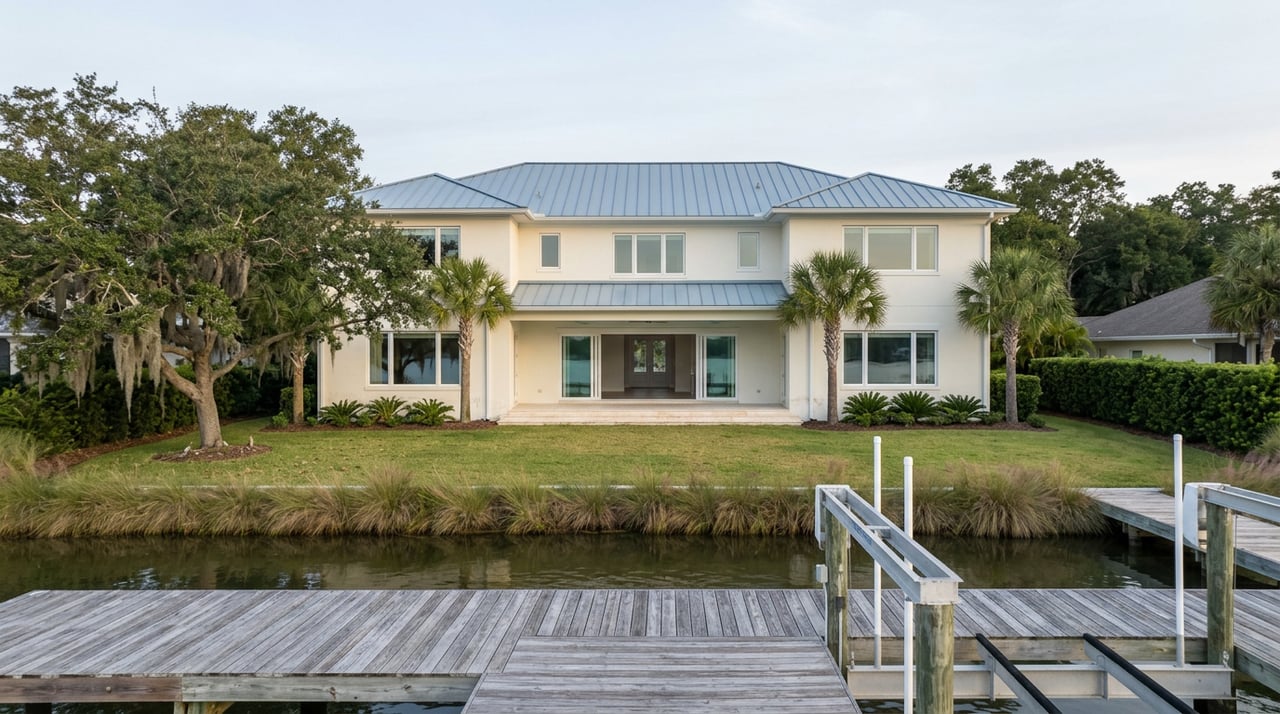
Two listings go up in the same week. Both say waterfront. Both show a dock in the hero photo. Both land within $50,000 of each other on price. A buyer touring both assumes they are choosing between two versions of the same thing.
Then the mortgage file moves to underwriting, and the numbers stop matching. One home has a flood policy that adds $300 a month to the payment. Nobody lied on either listing. The dock photos were real. But "waterfront" in Jacksonville is not a single product with a single price, and the gap between what it can mean is often the difference between a deal that closes on schedule and one that gets renegotiated ten days before the closing table.
That gap is the actual story. Not the median price, which any portal will show you, but the mechanism underneath it.
Four Markets, One Word
Jacksonville's water comes in enough varieties that grouping them under one label obscures more than it explains. The St. Johns River runs deep and wide through Ortega, San Marco, Avondale, and Mandarin, supporting real yacht traffic and the kind of point lots that carry deep-water docks. The Intracoastal Waterway behind the beaches supports gated communities like Queens Harbour and Marsh Landing, built around protected channel access to the ocean inlets, with entry pricing that commonly starts around $1.5 million. Tidal creeks and Doctors Lake southwest of the city offer boating too, but with shallower depths and lower bridges that cap what can actually get through. And along Heckscher Drive and Black Hammock Island, wide marsh views and back-river access come at a real discount to deep-water frontage, with dockage that depends on the tide.
Four different products. Four different price floors. A canal-front lot in Mandarin on a smaller waterway starts around $350,000, while a big-water St. Johns frontage lot in the same neighborhood, with a full dock setup, can run past $2 million. In Ortega, direct waterfront starts closer to $700,000 and climbs past $4 million for the largest riverfront estates, while a non-waterfront home two streets back can still be had from the $400s. Marsh and back-river lots along Heckscher Drive and Black Hammock Island generally run $525,000 to $1.6 million, trading deep-water access for privacy and lower density. None of these numbers describe the same thing, even though a search filter for "waterfront" returns all of them together.
| Water Type | Example Areas | Typical Price Range | What Actually Drives It |
|---|---|---|---|
| Deep-water river frontage | Ortega, San Marco, Avondale | $700K to $4M+ | Depth, dock condition, point-lot exposure |
| Canal or big-water river | Mandarin | $350K to $2M+ | Lot size, dock setup, waterway width |
| Gated Intracoastal | Queens Harbour, Marsh Landing | Entry around $1.5M | Guard gate, HOA amenities, protected channel |
| Marsh or back-river | Black Hammock Island, Heckscher Drive | $525K to $1.6M | Tide-dependent dockage, privacy, lower density |
You don't have to own frontage to live near the water here either. Riverside and Avondale border the St. Johns along their western and southern edges, and Memorial Park and Riverside Park put waterfront green space within walking distance of homes that don't carry a dock or a flood premium. For a buyer who wants the river as scenery rather than a boat slip, that's a legitimate fifth option, and often the cheapest one.
The Line That Actually Splits the Bill
Here is the part that doesn't show up in a listing photo. FEMA divides every Jacksonville parcel into a flood zone, and that zone, not the water view, is what actually determines the ongoing cost of owning the home.
Zone X means minimal flood risk. Zone AE premiums typically run somewhere in the $800 to $2,500 a year range through the NFIP depending on elevation, according to Move With Momentum. Zone VE is the coastal high-hazard designation, and premiums there commonly run $3,000 to $8,000 a year or more, on top of standard homeowners coverage.
Put those numbers into a full waterfront insurance stack, the combination of home coverage, wind, flood, and a dock rider, and the spread widens further. A typical $1 million river or Intracoastal home with a dock can carry $6,000 to $15,000 a year in combined premiums. A home with a river view but no direct frontage, sitting in Zone X on slightly higher ground, can run as low as $3,500 a year for the same total coverage. That's not a rounding difference. That's a monthly payment gap large enough to change what a buyer qualifies for.
The tricky part is that flood zone doesn't track neatly with neighborhood name. Much of central Riverside, Avondale, and San Marco sits in Zone X, but specific streets closer to the St. Johns River do not. Southside, Mandarin, and Northside are predominantly Zone X inland, but that changes fast near any tributary. Two homes on the same block can carry different designations. The only way to know for certain is to check the specific address, which FEMA's Flood Map Service Center makes free to do before writing an offer.
The Insurance Mandate That Just Widened Who This Affects
This got more relevant to Jacksonville buyers this year, not less. According to NSMN, Citizens Property Insurance, the state-backed insurer that covers a large share of Florida homes, began requiring flood coverage on policies for homes valued at $400,000 or more as of January 1, 2026. That requirement expands to cover all remaining Citizens policies starting January 1, 2027.
Read that against the price bands above. A Mandarin canal-front home at the entry end, a Black Hammock Island or Heckscher Drive marsh property at $525,000 and up, these are exactly the properties that used to slip past flood insurance requirements if their specific parcel happened to sit in Zone X. Under a Citizens policy, home value now triggers the requirement independent of zone. A buyer comparing two "affordable" waterfront-adjacent listings this fall needs to ask not just what zone the home sits in, but who is likely to insure it and what that carrier requires at the current appraised value.
The Dock Has Its Own Inspection
A standard home inspection in Florida checks the roof, the systems, the four-point items an insurer wants to see. It does not evaluate the dock. On any waterfront property with a lift, boathouse, or visible seawall, that's a separate discipline, and skipping it is how buyers inherit a $30,000 repair six months after closing.
A dedicated dock and seawall survey runs $400 to $900 and checks things a general inspector isn't trained to catch: piling deterioration below the waterline, lift cable wear, whether the electrical bonding meets code, and how the structure attaches to the seawall itself. On a point lot in Ortega or any property where the dock is doing real work for the price, this is not an optional add-on. It's the marine equivalent of a roof certification, and lenders increasingly expect to see one before closing on anything with a boathouse attached.
Depth and Bridges Decide What the Water Is Actually For
The last piece buyers underestimate is navigability, which has nothing to do with how the property looks from the yard and everything to do with what happens between the dock and open water. A deep-water lot off Ortega or directly on the Intracoastal can handle a genuinely large boat. A lot on a tidal creek or Doctors Lake might not, depending on water depth at low tide and the clearance under any fixed bridges between the dock and the river.
This matters most for buyers moving here with a specific vessel in mind. A shallow tidal-creek lot that looks identical to a deep-water lot in photos can mean the difference between keeping a center console and needing a smaller boat entirely. Before assuming a dock means unrestricted access, confirm the depth, the route to open water, and any existing dock permits tied to the property.
Not every buyer is chasing horsepower. Jacksonville also holds the Timucuan Ecological and Historic Preserve, a 46,000-acre national preserve inside the city limits with miles of paddling routes through undisturbed salt marsh. For a buyer whose idea of waterfront living is a kayak launch rather than a yacht slip, marsh-front property near the preserve delivers that at a fraction of deep-water pricing, without needing to solve for bridge clearance at all.
A Few Quick Answers
Does a water view without frontage really cost less to insure than direct waterfront? Generally yes. A home in Zone X with a river view but no dock or bulkhead can run near the low end of the insurance stack, often thousands less per year than a comparable home with direct frontage in Zone AE or VE.
Can I keep a full-size boat on a marsh-front lot in Black Hammock Island or along Heckscher Drive? It depends on the tide and the depth at your specific dock. Back-river and marsh dockage in these areas is frequently tide-dependent, which is part of why prices run below deep-water frontage elsewhere in the city.
Do all of Jacksonville's waterfront communities allow short-term rental? No, and this varies enough that it's worth confirming before you buy with that use in mind. Many HOA-controlled gated communities restrict or prohibit short-term rentals entirely, so zoning and HOA rules deserve a look before contract, not after.
Waterfront in Jacksonville isn't one market wearing different price tags. It's several markets that happen to share a word, and the only way to know which one you're actually looking at is to check the flood zone, the dock survey, and the depth chart before you fall for the photo. If you're comparing listings that all say waterfront and want to know what each one actually means for your budget and your boat, Donna S Osteen can walk through the specifics with you before you write an offer.
This article is general information, not legal, tax or financial advice. Consult a qualified professional about your situation.